
H3+
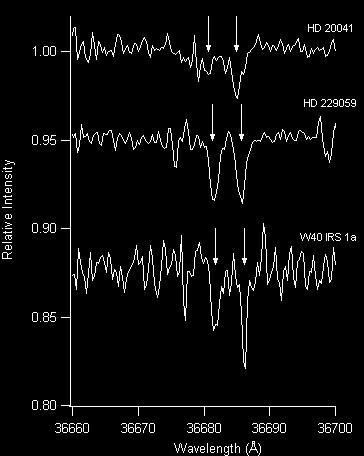
Spectra of three interstellar clouds showing absorption lines due to the R(1,1)u and R(1,0) transitions of H3+. Arrows indicate the expected positions of the absorption features from previous measurements of the interstellar gas velocity.
Observations
H3+ is extremely important to the chemistry of interstellar clouds. This is because H3+ willingly donates its extra proton to a variety of collision partners, thus laying the foundation for a large network of ion-molecule reactions.
The reactions surrounding the formation and destruction of H3+ are relatively simple. It is generally assumed that a cosmic ray first ionizes H2, which then collides with another H2 molecule to form H3+ and H. In diffuse clouds H3+ is destroyed via electron recombination, while in dense clouds destruction primarily occurs by charge tranfer with CO. This overall simplicity allows observations of H3+ to be used in estimating the ionization rate of H2 due to cosmic rays.
The cosmic-ray ionization rate in the ISM has previously been estimated using various molecular tracers such as OH, HD, HCO+, and H3O+. While these studies have found an average value of about 10-17 s-1, individual results have varied over a few orders of magnitude. Using the United Kingdom Infrared Telescope, we have observed H3+ absorption in several diffuse molecular cloud sight lines and inferred an average ionization rate of 4x10-16 s-1. Because the chemistry behind H3+ is so much simpler than for the other tracers, we believe that this is the most accurate determination of the cosmic-ray ionization rate to date.
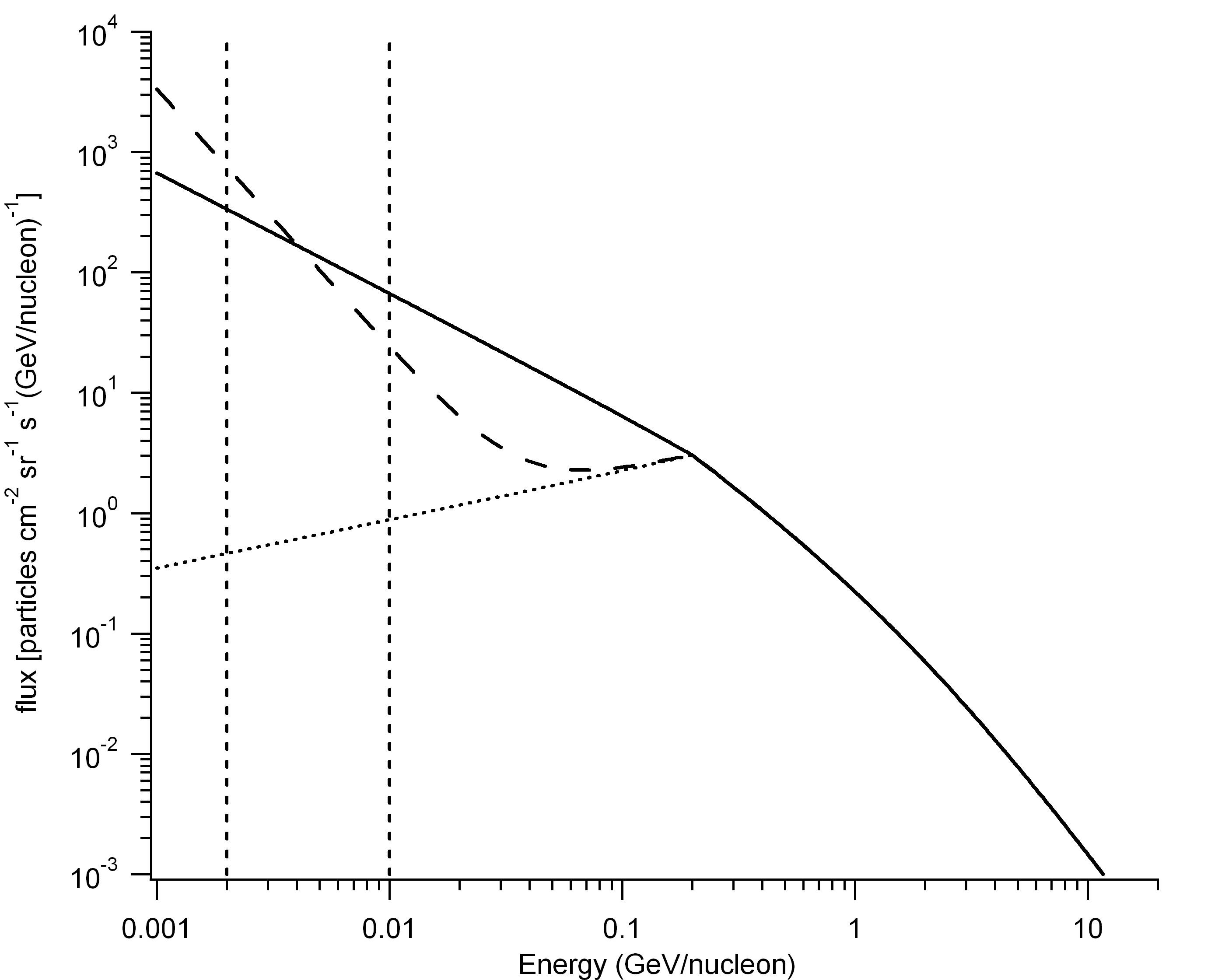
Three theoretical distributions of the differential cosmic-ray flux at low energies. These cosmic-ray spectra were used with various cross sections to predict the ionization rate of atomic hydrogen, light element isotope production rates, and gamma-ray line fluxes. Click for full size.
Theoretical Calculations
In addition to ionizing H and H2, cosmic rays can also spall atomic nuclei and excite atomic nuclear states. Spallation of C, N, and O will produce the light element isotopes 6Li, 7Li, 9Be, 10B, and 11B, while nuclear excitation of 12C and 16O will emit 4.4 MeV and 6.1 MeV gamma rays, respectively. Exactly how much these processes occur depends on the energy spectrum of cosmic rays in the 1 MeV - 10 GeV range. Unfortunately, cosmic rays in this energy range are unobservable at the Earth due to the solar wind. As a result, we have tested multiple low energy spectra in an attempt to reproduce light element, gamma ray, and ionization observations. From our study, it seems that the power law distribution of cosmic rays at low energies must be steeper than that observed at high energies. One possible explanation for such a discrepancy is that each population is accelerated by a different mechanism, although this is contrary to the current belief that all Galactic cosmic rays are accelerated in supernova remnants. We continue to study this problem in an attempt to better constrain the cosmic-ray spectrum at low energies.
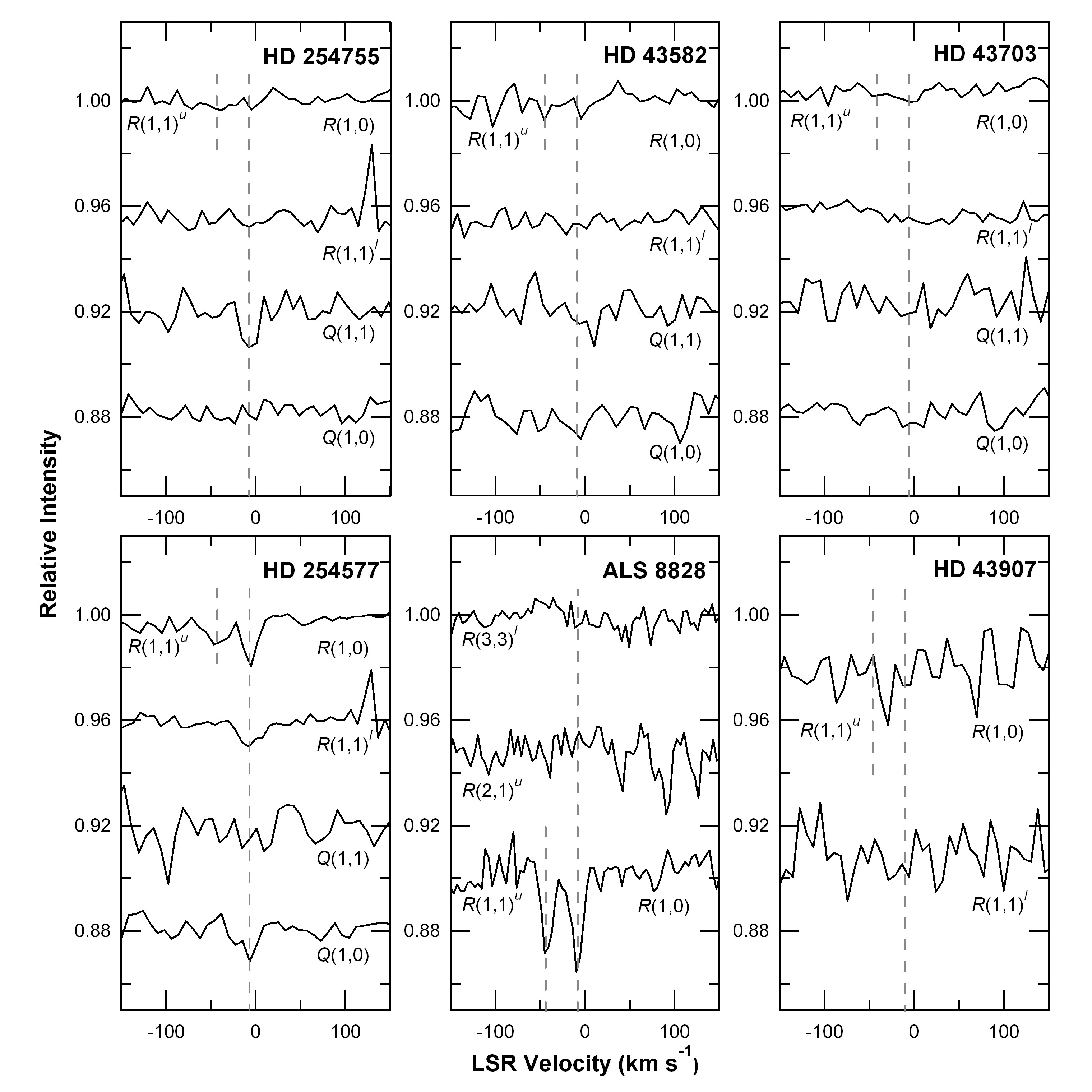
Spectra covering various H3+ transitions in 6 sight lines near the supernova remnant IC 443. Click for full size.
H3+ Near Supernova Remnants
We recently searched for H3+ absorption in sight lines which pass through molecular material in close proximity to the supernova remnant IC 443. If supernova remnants do accelerate a large number of low-energy cosmic rays, then the ionization rate in such a region should be rather high. Spectra were obtained using the Keck and Subaru Telescopes, and are shown for the six target sight lines in this study. The sight lines toward HD 254577 and ALS 8828 show large column densities of H3+, and indicate ionization rates of about 2x10-15 s-1, higher than previously found toward any diffuse cloud. This suggests that supernova remnants do in fact accelerate a large population of low-energy cosmic rays. However, it is still unclear whether or not such a population can propagate far enough from remnants to account for the high ionization rate inferred toward several Galactic diffuse cloud sight lines. Future studies of H3+ in molecular material near supernova remnants should help to further our understanding on the subject.
Related Content
Papers
| 77 | N. Indriolo and B. J. McCall "Cosmic-ray Astrochemistry" Chemical Society Reviews (2013), 42, 7763-7773. |
 |
 |
| 70 | F. Grussie, M. H. Berg, K. N. Crabtree, S. Gärtner, B. J. McCall, S. Schlemmer, A. Wolf, and H. Kreckel "The Low-Temperature Nuclear Spin Equilibrium of H3+ in Collisions With H2" Astrophysical Journal (2012), 759, 21. |
|
|
| 68 | K. N. Crabtree and B. J. McCall "The ortho:para ratio of H3+ in laboratory and astrophysical plasmas" Philosophical Transactions of the Royal Society A (2012), 370, 5055-5065. |
|
|
| 65 | N. Indriolo and B. J. McCall "Investigating the Cosmic-Ray Ionization Rate in the Galactic Diffuse Interstellar Medium through Observations of H3+" Astrophysical Journal (2012), 745, 91. |
|
|
| 59 | M. Goto, T. Usuda, T. R. Geballe, N. Indriolo, B. J. McCall, T. Henning, and T. Oka "Absorption-Line Survey of H3+ toward the Galactic Center Sources. III. Extent of Warm and Diffuse Clouds" Publications of the Astronomical Society of Japan (2011), 63, L13-L17. |
|
|
| 56 | K. N. Crabtree, N. Indriolo, H. Kreckel, B. A. Tom and B. J. McCall "On the Ortho:Para Ratio of H3+ in Diffuse Molecular Clouds" Astrophysical Journal (2011), 729, 15. |
|
|
| 52 | N. Indriolo, G. A. Blake, M. Goto, T. Usuda, T. Oka, T. R. Geballe, B. D. Fields and B. J. McCall "Investigating the Cosmic-Ray Ionization Rate Near the Supernova Remnant IC 443 through H3+ Observations" Astrophysical Journal (2010), 724, 1357-1365. |
|
|
| 37 | M. Goto, T. Usuda, T. Nagata, T. R. Geballe, B. J. McCall, N. Indriolo, H. Suto, T. Henning, C. P. Morong and T. Oka "Absorption Line Survey of H3+ toward the Galactic Center Sources II. Eight Infrared Sources within 30 pc of the Galactic Center" Astrophysical Journal (2008), 688, 306–319. |
|
|
| 33 | N. Indriolo, T. R. Geballe, T. Oka and B. J. McCall "H3+ in Diffuse Interstellar Clouds: A Tracer for the Cosmic-Ray Ionization Rate" Astrophysical Journal (2007), 671, 1736–1747. |
|
|
| 31 | B. J. McCall "Dissociative Recombination of Cold H3+ and its Interstellar Implications" Philosophical Transactions of the Royal Society of London Series A (2006), 364, 2953-2963. |
|
|
Proceedings
| 14 | N. Indriolo, B. D. Fields and B. J. McCall "Probing cosmic-ray acceleration and propagation with H3+ observations" Proceedings of the International Conference of Computational Methods in Sciences and Engineering, AIP Conference Proceedings, Eds. T. E. Simos and G. Maroulis, AIP, (2015), 1642, 370. |
|
|
| 15 | M. Goto, T. R. Geballe, T. Usuda, N. Indriolo, B. J. McCall and T. Oka "Gas in the CMZ toward the Galactic nucleus studied by H3+ and CO spectra" Proceedings of the International Conference of Computational Methods in Sciences and Engineering, AIP Conference Proceedings, Eds. T. E. Simos and G. Maroulis, AIP, (2015), 1642, 377. |
|
|
| 16 | K. N. Crabtree, N. Indriolo, H. Kreckel and B. J. McCall "The ortho:para ratio of H3+ in laboratory and astrophysical plasmas" Proceedings of the International Conference of Computational Methods in Sciences and Engineering, AIP Conference Proceedings, Eds. T. E. Simos and G. Maroulis, AIP, (2015), 1642, 380. |
|
|
Talks
| 131 | N. C. Koeppen and B. J. McCall "Inferring the Temperature and Density of Diffuse Interstellar Clouds from C3 Observations" Seventieth International Symposium on Molecular Spectroscopy, University of Illinois, Urbana-Champaign, IL, 2015. |
|
 |
| 111 | K. N. Crabtree and B. J. McCall "Nuclear Spin of H3+ and H2 in Dense Molecular Clouds" Sixty-Seventh International Symposium on Molecular Spectroscopy, The Ohio State University, Columbus, OH, 2012. |
|
|
| 97 | N. Indriolo, T. Oka, T. R. Geballe and B. J. McCall "Investigating the Cosmic-Ray Ionization Rate in the Galactic Interstellar Medium through Observations of H3+" Sixty-Sixth International Symposium on Molecular Spectroscopy, The Ohio State University, Columbus, OH, 2011. |
|
|
| 98 | K. N. Crabtree, N. Indriolo, H. Kreckel, B. A. Tom and B. J. McCall "Nuclear Spin of H3+ in Diffuse Molecular Clouds" Sixty-Sixth International Symposium on Molecular Spectroscopy, The Ohio State University, Columbus, OH, 2011. |
|
|
| 89 | K. N. Crabtree, N. Indriolo, H. Kreckel, B. A. Tom and B. J. McCall "The ortho:para Ratio of H3+ in Diffuse Molecular Clouds" Midwest Astrochemistry Meeting, University of Illinois, Urbana, IL, 2010. |
|
|
| 87 | K. N. Crabtree, N. Indriolo, H. Kreckel and B. J. McCall "The ortho:para Ratio of H3+ in Laboratory and Astrophysical Plasmas" Spectroscopy of Molecular Ions in the Laboratory and in Space, Kos, Greece, 2010. |
|
|
| 86 | N. Indriolo, B. D. Fields and B. J. McCall "Probing Cosmic Ray Propagation and Acceleration with H3+ Observations" Spectroscopy of Molecular Ions in the Laboratory and in Space, Kos, Greece, 2010. |
|
|
| 84 | N. Indriolo, G. A. Blake, M. Goto, T. Usuda, T. R. Geballe, T. Oka and B. J. McCall "Constraining the Flux of Low-Energy Cosmic Rays Accelerated by the Supernova Remnant IC 443" Sixty-Fifth International Symposium on Molecular Spectroscopy, The Ohio State University, Columbus, OH, 2010. |
|
|
| 75 | N. Indriolo, T. Oka, T. R. Geballe, K. H. Hinkle, G. A. Blake and B. J. McCall "Comparing the Ortho-to-Para Ratios of H2 and H3+ in Diffuse Interstellar Clouds" Sixty-Fifth International Symposium on Molecular Spectroscopy, The Ohio State University, Columbus, OH, 2010. |
|
|
| 72 | K. N. Crabtree, B. A. Tom, C. A. Kauffman, B. A. McGuire and B. J. McCall "Implications of the H3+ + H2 → H2 + H3+ Reaction for the ortho- to para-H3+ Ratio in Interstellar Clouds" 239th American Chemical Society National Meeting, San Francisco, CA, 2010. |
|
|
| 66 | N. Indriolo, T. R. Geballe, T. Oka and B. J. McCall "Variability of the Cosmic-Ray Ionization Rate in Diffuse Molecular Clouds" Sixty-Fourth International Symposium on Molecular Spectroscopy, The Ohio State University, Columbus, OH, 2009. |
|
|
| 60 | B. J. McCall "H3+: The Simplest Polyatomic Molecule in the Laboratory and in the Interstellar Medium" Advancing Chemical Understanding Through Astronomical Observations, Green Bank Telescope, Green Bank, WV, 2009. |
|
|
| 50 | N. Indriolo, B. D. Fields, and B. J. McCall "Constraining the Low-Energy Cosmic-Ray Spectrum" Sixty-Third International Symposium on Molecular Spectroscopy, Ohio State University, Columbus, OH, 2008. |
|
|
| 43 | B. J. McCall "H3+ and the Cosmic Ray Flux" The Molecular Universe, Arcachon, France, 2008. |
|
|
| 36 | N. Indriolo, B. J. McCall, T. R. Geballe, and T. Oka "H3+ in Diffuse Interstellar Clouds: A Tracer for the Cosmic-Ray Ionization Rate" Sixty-Second International Symposium on Molecular Spectroscopy, Ohio State University, Columbus, OH, 2007. |
|
|
| 31 | B. J. McCall "A Tracer of the Cosmic Ray Ionization Rate in Diffuse Clouds" Enrico Fermi Institute Mini-Symposium on, Chicago, Illinois, 2007. |
|
Posters
| 27 | K. N. Crabtree, N. Indriolo, H. Kreckel, B. A. Tom, C. A. Kauffman, E. Becka, B. A. McGuire and B. J. McCall "Nuclear Spin Dependence of Hydrogenic Plasmas in the Laboratory and the Diffuse Interstellar Medium" Midwest Astrochemistry Meeting, University of Illinois, Urbana, IL, 2011. |
|
|
| 24 | K. N. Crabtree, N. Indriolo, H. Kreckel, B. A. Tom, C. A. Kauffman, E. Beçka, B. A. McGuire and B. J. McCall "Nuclear Spin Dependence of Hydrogenic Plasmas in the Laboratory and the Diffuse Interstellar Medium" International Astronomical Union Symposium 280: The Molecular Universe, Universidad Castilla la Mancha, Toledo, Spain, 2011. |
|
|
| 19 | H. Kreckel, K. N. Crabtree, C. A. Kauffman, B. A. Tom, N. Indriolo, B. A. McGuire, O. Novotny, M. Berg, D. Bing, H. Buhr, A Petrignani, C. Krantz, M. Lestinky, M. Mendes, C. Nordhorn, J. Stützel, R. Thomas, A. Wolf and B. J. McCall "Nuclear Spin Effects in the Reactions of H3+ with H2 and Electrons" Spectroscopy of Molecular Ions in the Laboratory and in Space, Kos, Greece, 2010. |
|
|
| 18 | K. N. Crabtree, N. Indriolo, H. Kreckel, C. A. Kauffman, E. Becka, B. A. Tom and B. J. McCall "Nuclear Spin Effects in Hydrogenic Plasmas in the Laboratory and Interstellar Medium" Gordon Research Conference on Atomic and Molecular Interactions, Colby-Sawyer College, New London, NH, 2010. |
|
|
| 13 | N. Indriolo, T. R. Geballe, T. Oka and B. J. McCall "Variability of the Cosmic-Ray Ionization Rate in Diffuse Molecular Clouds" Advancing Chemical Understanding Through Astronomical Observations, Green Bank Telescope, Green Bank, WV, 2009. |
|
Other Publications
| 29 | K. N. Crabtree "Chemical Physics and Astrochemistry of H3+ and Sub Doppler Mid Infrared Spectroscopy of Molecular Ions" Ph. D. Thesis, University of Illinois, 2012. |
|
|
| 27 | N. Indriolo "Investigating the Cosmic-Ray Ionization Rate in the Galactic Interstellar Medium through Observations of H3+" Ph.D. Thesis, University of Illinois, 2011. |
|
|
| 16 | N. Indriolo "Astrochemical Constraints on the Cosmic-Ray Ionization Rate" Research Prospectus for Preliminary Examination, Department of Astronomy, University of Illinois, 2008. |
|